I2-NeRF: Learning Neural Radiance Fields
Under Physically-Grounded Media Interactions
NeurIPS 2025
Shuhong Liu 1, Lin Gu 2, Ziteng Cui 1, Xuangeng Chu 1, Tatsuya Harada 1,2
1The University of Tokyo, 2RIKEN AIP
Overview
I2-NeRF is a physically grounded NeRF framework designed for media-degraded environments such as underwater, haze, and low-light scenes. The method combines:
- A general radiative formulation that unifies emission, absorption, and scattering under the Beer–Lambert law, covering various media types.
- A media-aware sampling strategy that allocates samples both on object surfaces and in low-density volumes, avoiding severe undersampling of the medium itself.
- Metric, isotropic perception enabled by explicitly modeling downwelling attenuation, so that the reconstructed field is consistent across directions once a global scale is known.
Abstract
we propose I2-NeRF, a novel neural radiance field framework that enhances isometric and isotropic metric perception under media degradation. While existing NeRF models predominantly rely on object-centric sampling, I2-NeRF introduces a reverse-stratified upsampling strategy to achieve near-uniform sampling across 3D space, thereby preserving isometry. We further present a general radiative formulation for media degradation that unifies emission, absorption, and scattering into a particle model governed by the Beer–Lambert attenuation law. By composing the direct and media-induced in-scatter radiance, this formulation extends naturally to complex media environments such as underwater, haze, and even low-light scenes. By treating light propagation uniformly in both vertical and horizontal directions, I2-NeRF enables isotropic metric perception and can even estimate medium properties such as water depth. Experiments on real-world datasets demonstrate that our method significantly improves both reconstruction fidelity and physical plausibility compared to existing approaches.
A Unified Model For Various Degradation Scenarios
We unify degradations with one radiative formulation: Observation = Emission × Absorption + Scattering.
\( I \;=\; T\,J \;+\; \int_{0}^{z} T(0,t)\,S(t)\,dt \;\;\approx\;\; T\,J \;+\; (1-T)\,B \), with transmittance \( T=\exp(-\sigma\,z) \).
- Underwater. Wavelength-dependent extinction and backscatter: \( I(\lambda)=J(\lambda)\,e^{-\sigma(\lambda)z} \;+\; B_{\infty}(\lambda)\,\bigl(1-e^{-\sigma(\lambda)z}\bigr) \).
- Haze. Single extinction \( \sigma \) with air-light: \( I = J\,e^{-\sigma z} \;+\; A\,(1-e^{-\sigma z}) \).
- Low-light. Modeled as a virtual absorption field with negligible in-scatter: \( I \approx J\,e^{-\sigma z} \).
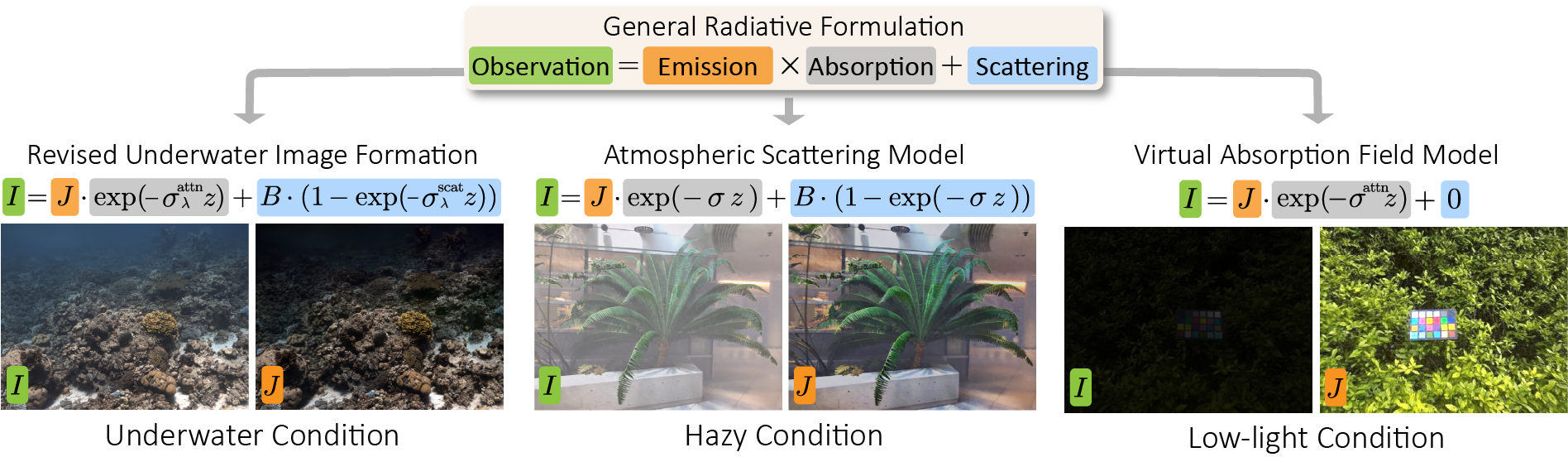
General Radiative Formulation
We decompose a camera ray into Emission (scene radiance \(J\)), Absorption (Beer–Lambert transmittance \(T\)), and Scattering (isotropic in-scatter). We also model downwelling attenuation with vertical light traveling distance, so the illumination that feeds the in-scatter decays as \(L_{\downarrow}(h)=\Phi\,e^{-\sigma z^{\Phi}}\). This keeps propagation consistent along the view direction and height, enabling isotropic, metric-faithful reconstruction.
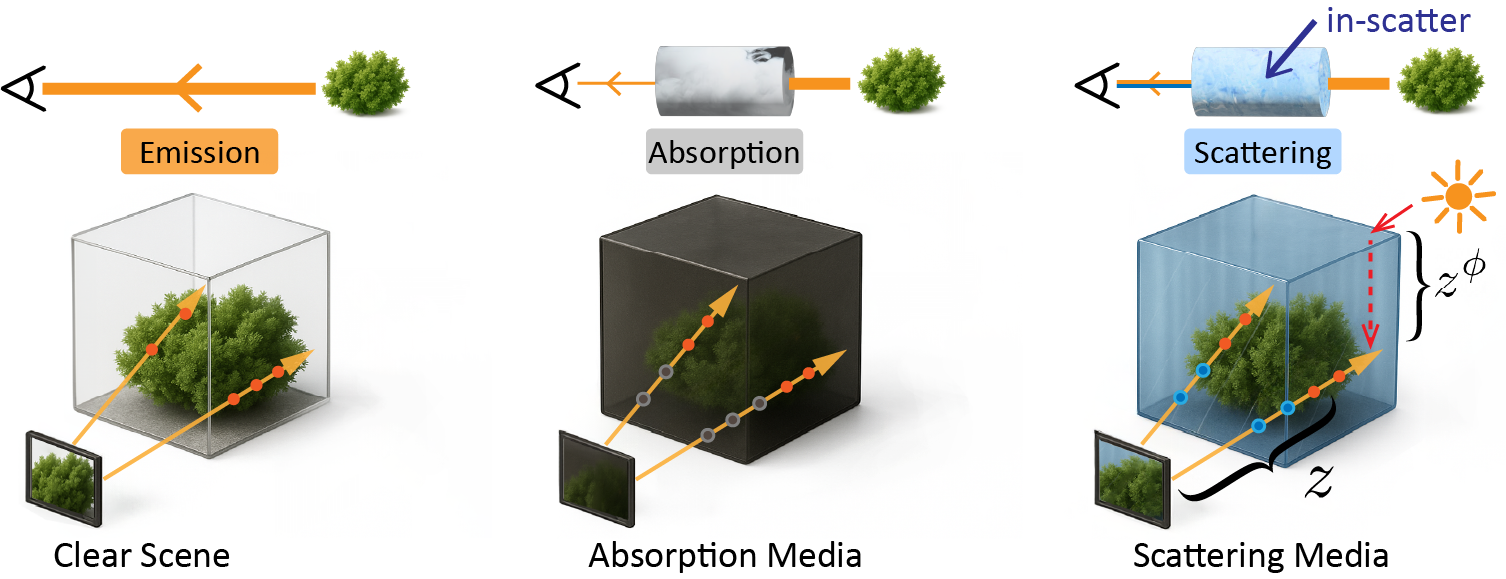
Experimental Results
Lowlight Condition
If the video doesn’t play, open the MP4.
Water Scattering Condition
If the video doesn’t play, open the MP4.
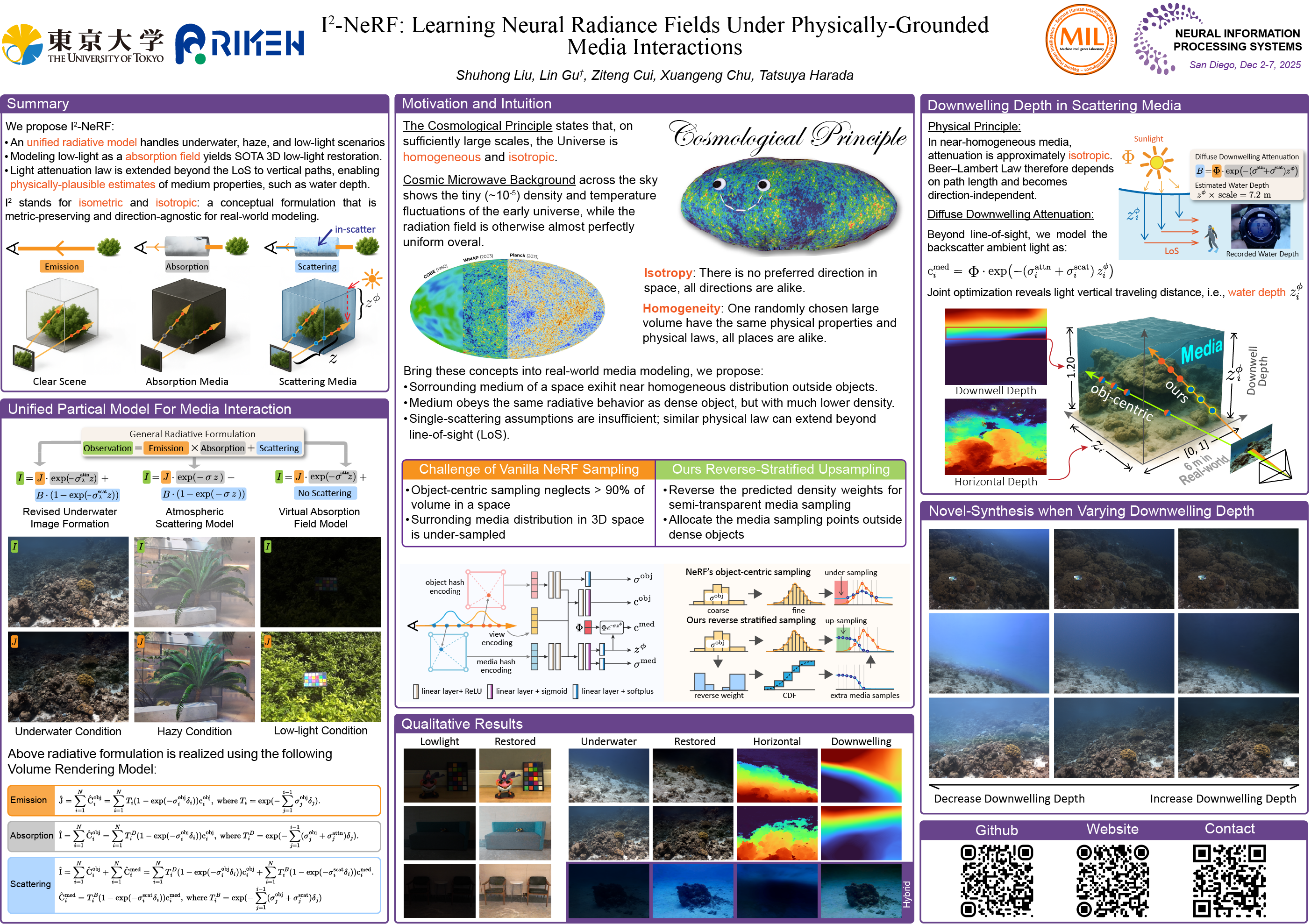
Poster
Click the poster to view it in full resolution.
BibTeX
@inproceedings{liu2025i2nerf,
  title     = {I2-NeRF: Learning Neural Radiance Fields Under Physically-Grounded Media Interactions},
  author    = {Liu, Shuhong and Gu, Lin and Cui, Ziteng and Chu, Xuangeng and Harada, Tatsuya},
  booktitle = {Advances in Neural Information Processing Systems (NeurIPS)},
  year      = {2025},
}